Java Applet Code For Front Page Screenshots


Video Tutorial


The Vista Buttons add-in for Expression Web and Frontpage allows you to create powerful dropdown menu menus, directly in Expression Web, FrontPage 2000 (version 9), Microsoft FrontPage 2002 (version 10), Microsoft Office FrontPage 2003 (version 11). Fully customizable appearance! Use one of the 500+ web buttons, 100 submenu designs, 6600+ icons, 50 ready-made samples, or create your own using the theme editor. With support for custom images, icons, colors, font styles, the possibilities are limitless. You'll create really nice looking website html menus and html buttons with little or no design skills at all! Create, insert, modify a website menu without leaving your favorite web development environment!


Menu, Button, and Icon Collection

Expression Web Menu provides huge collection of 1400 web buttons, 6600 icons, 300 ready-made samples, so you'll create really nice looking menus and buttons with little or nodesign skills at all! Web 2.0, Mac, iPhone, Aqua buttons, Vista, XP, transparent, round, glossy, metallic, 3d, tab menus, drop down menus will be a breeze!

Button and Icon Samples

Features

Create your own button themes
Theme editor helps you create your own themes or modify existing ones.

Gloss Finish Canvas Xaml Expression Blend Fonts, Borders and Background Colors
Use any necessary font of any color, size and font decoration for normal and mouseover state. Create any available type, thickness and color of a menu's frame. Choose any color for backgrounds of submenus and items.

Barra Del Menu De Frontpage Widest cross-browser compatibility
The html menus generated by Expression Web Menu run perfectly on all old and new browsers, including IE5,6,7,8, Firefox, Opera, Safari and Chrome on PC, Mac, and Linux. Expression Web Menu menus have a structure based on HTML list of links (LI and UL tags), readable by any search-engine robots and text browsers.

Expression Web 3 Build Css Menus Java Applet Code For Front Page Easy to Use
With Vista Web Buttons clear and comprehensible interface, you need just 4 simple steps to get your web buttons or html menu ready and if you use a pre-designed sample as a base you'll end up even faster!

Search Engine Friendly
Expression Web Menu generates html code which is transparent to search spiders.

Orientation of the Menu
Create both horizontal and vertical menus and submenus with any amount of menus on one page.


2.0 Buttons by Web-Buttons.com v3.0.0

How to use Vista Buttons with FrontPage

    To install the popup menu into your html page you should do the following things:

    1). Create and save your buttons in any temp folder using Vista Buttons application. You canuse "Save as HTML" function.
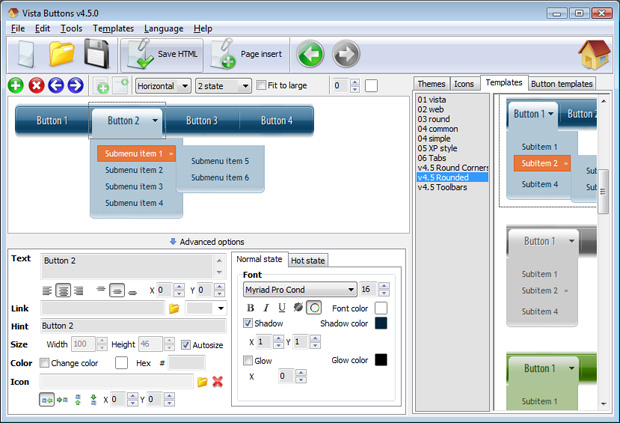
    Save menu

    You can enter any name you like, for example enter "menu":
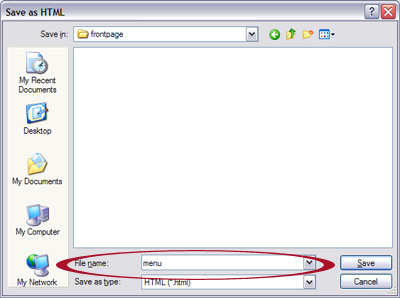
    Save menu name

    So you'll have menu.html file and "menu-files" folder with all menu files.
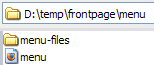
    Generated files

    2). You can add javascript popup menu to a single page or to many pages using Shared Borders, Include Page or Dynamic Web Template so that you won't have to add it into each page separately.

    Insert a popup menu to many pages using Dynamic Web Template in FrontPage

    - Start FrontPage and open your website. When the website opens, it should look like this:

    Open website in FrontPage

    - To create the Dynamic Web Template you should do the following things:
    Create a new folder in the root of your website, for example "menu". In this folder create a new Blank Page and name it menu.dwt.

    Dynamic Web Templates

    - Now you can add a menu in Dynamic Web Template. Open menu.dwt page (double-click menu.dwt in Folder list window) and switch to the Design view mode. Decide where you would like the popup menu to appear in your page. Click in the spot you want the code to appear in and type the phrase: your code

    Dynamic Web Templates add menu

    - Open the generated in Vista Buttons menu.htmlpage in any text editor. Copy all code within the following tags:
          <!-- Begin Vista-Buttons.com -->
            ...
          <!-- End Vista-Buttons.com -->

    - We will now be inserting the JavaScript code into the body section right where we typed the phrase in the previous step. To do this, switch to HTML View.

    - Go to the "Edit Menu" with FrontPage and select the "Paste" option to paste the menu code that we copied to the clipboard earlier. Since the phrase we typed was highlighted, it will be replaced when we paste the code in.

    Dynamic Web Templates add menu code

    - To display the mouseover state images correctly you should change vbImgPath parameter. Find the following code
    var vbImgPath="menu-files/"
    and change it to
    var vbImgPath="menu/menu-files/"

    Change path prefix in FrontPage

    - Now you should copy the "menu-files" folder into the same folder with your menu.dwt page.

    Copy menu files in FrontPage

    - Select the Preview mode to display the menu.dwt page live (in Internet Explorer). Notice that your mouseover images can be not displayed when you hover over menu items in the Preview mode. It is normal. You'll see all images when you open index.htm page in the Preview mode.

    Preview mode in FrontPage

    - Add editable regions to a Dynamic Web Template.
    a. Open the Dynamic Web Template (.dwt) file.
    b. In Page view, at the bottom of the document window, click Design.
    c. Put your cursor below the menu
    d. Right-click and then click Manage Editable Regions.
    e. In the Region name box, type a name for the editable region, for example, Header, Body, or Footer.
    f. Click Add, and then click Close.

    Dynamic Web Templates Editable Regions

    - Attach a Dynamic Web Template to your pages.
    a. Open the Web page you want to attach a Dynamic Web Template to.
    To attach the Dynamic Web Template to more than one page, select the pages you want.
         * In the Folder List, hold down CTRL and click each page you want.
         * If the Folder List is hidden, click Folder List on the View menu.
    b. On the Format menu, point to Dynamic Web Template, and then click Attach Dynamic Web Template.
    c. Locate and click the Dynamic Web Template (menu.dwt) you want to attach, and then click Open.
    d. In the appeared windows click "Ok" and then click "Close".

    Dynamic Web Templates Attach Template

    - That's all. You've added all necessary code to your page, so let's test it. Open your index page (double-click index.htm in Folder list window) and switch to the Preview mode.

    Result

    - If everything goes well, save and publish your website. If something seems wrong, double-check that you followed all the steps correctly.

    - If you still run into trouble, we'd be happy to assist you further. You can post your problem to us at , and meanwhile describe your files in details.


Support

Please contact Customer Support at (please include template name in the message title)


FAQ


See also

Java Guitar Tuner Guitar Tuner source code. New! If you don't want to connect to the Net to Back to Dreadscott's Java Applets Page. Kitschen Sink: Java Virtual Art Room

How to Insert a Java Applet With Dreamweaver | eHow.com Applets are small pieces of Java code that can be embedded in a Web page; they typically perform small tasks, like animating text. While Java is a full-fledged programming

Sample: The Java Programming Language and Exit from it before working on the applet code. In vi you can use something like this: :!java %:!netscape test.page a word placed in front of a declaration that

Creating an Applet from an Application (The Java Tutorials In our example, the applet code is in the file OutputApplet.java. To display our applet in an HTML page, the file OutputApplet.html tells the browser what to display and

How to Insert a Java Applet With Dreamweaver | eHow.com Applets are small pieces of Java code that can be embedded in a Web page; they typically perform small tasks, like animating text. While Java is a full-fledged programming

HTML Applets - HTML Code Tutorial How to put Java applets on your web page. An applet is a miniature program that you embed right into your web page.

How to Add Java Applets to a Web Page With FrontPage | eHow.com How to Add Java Applets to a Web Page With FrontPage. Adding Java applets is simple using FrontPage Applets, like scripts and Web pages, are proprietary pieces of code

The Base Java Security Model: The Original Applet Sandbox A browser that can interpret Java byte code (such pointing your browser at a Web page containing an applet, you start Java. Front-- Contents-- Help. Copyright �1999

Java sample code - Calculator In Java - Source code examples Calculator In Java sample code source code examples The Internet Marketer's alternative to Dreamweaver, Front Page and ExpressionWeb

Java sample code - Timer Applet - Source code examples The Internet Marketer's alternative to Dreamweaver, Front Page and Java > Java Applets sample source codes Timer Applet

The Java Boutique The Java Boutique is a collection of applets that you can put on your own pages. It also features Java news, links HP Buys Fortify to Boost Application Code Analysis Next

Signing Java Applets with Microsoft's Authenticode (Appdx. C, Sec Previous Page archive format IE supports for signing Java code. Say we have an applet <APPLET CODE="MyApplet.class"> <PARAM name="cabbase

Java Applets Java Applets. Applets are "mini applications But in reality, the applet code is the same each time; the web page contains the Javamex blog (see the site's front page

HTML Applets - HTML Code Tutorial How to put Java applets on your web page. An applet is a miniature program that you embed right into your web page.

javadoc-The Java API Documentation Generator This is the front page of the src-html Source code directory java Package directory applet Subpackage Applet.html Page for Applet source code

Signing Java Applets with Microsoft's Authenticode (Appdx. C, Sec Previous Page archive format IE supports for signing Java code. Say we have an applet <APPLET CODE="MyApplet.class"> <PARAM name="cabbase