Expression Web Image Binding Screenshots


Video Tutorial


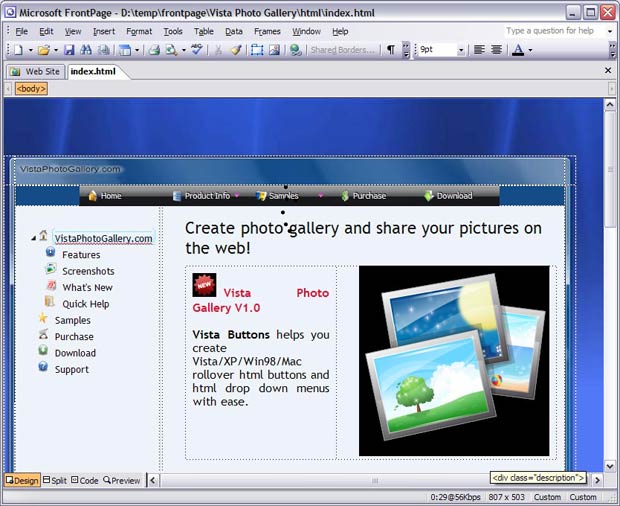
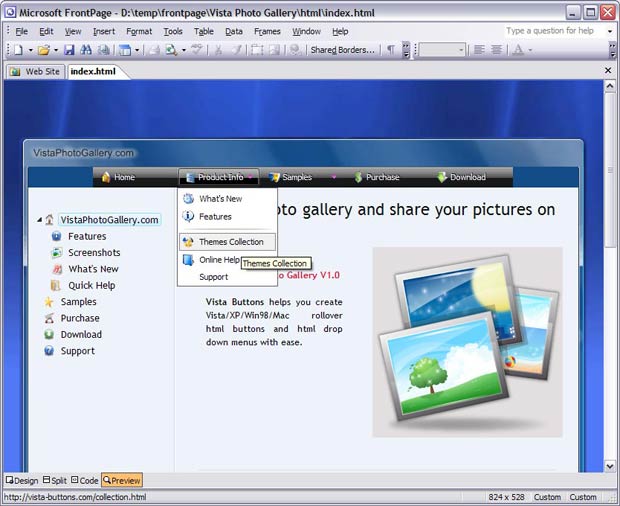
The Vista Buttons add-in for Expression Web and Frontpage allows you to create powerful dropdown menu menus, directly in Expression Web, FrontPage 2000 (version 9), Microsoft FrontPage 2002 (version 10), Microsoft Office FrontPage 2003 (version 11). Fully customizable appearance! Use one of the 500+ web buttons, 100 submenu designs, 6600+ icons, 50 ready-made samples, or create your own using the theme editor. With support for custom images, icons, colors, font styles, the possibilities are limitless. You'll create really nice looking website html menus and html buttons with little or no design skills at all! Create, insert, modify a website menu without leaving your favorite web development environment!


Menu, Button, and Icon Collection

Expression Web Menu provides huge collection of 1400 web buttons, 6600 icons, 300 ready-made samples, so you'll create really nice looking menus and buttons with little or nodesign skills at all! Web 2.0, Mac, iPhone, Aqua buttons, Vista, XP, transparent, round, glossy, metallic, 3d, tab menus, drop down menus will be a breeze!

Button and Icon Samples

Features

Size
You can set the size of the menu in pixels.

Expression Web Mini Logo On Tab Easy to Use
With Vista Web Buttons clear and comprehensible interface, you need just 4 simple steps to get your web buttons or html menu ready and if you use a pre-designed sample as a base you'll end up even faster!

Expanding Navigation Bar Frontpage Great Looking Web Navigation with Minimum Effort
Expression Web Menu provides 500+ web buttons, 100 submenu designs, 6600+ icons, 50 ready-made samples, so you'll create really nice looking website html menus and html buttons with little or no design skills at all! Vista, XP, Win98, Mac, Aqua buttons, round, glossy, metallic, 3d styles, tab menus, drop down menus will be a breeze!

Fireworks Rollover Buttons In Frontpage 2002 Expression Web Image Binding Search Engine Friendly
Expression Web Menu generates html code which is transparent to search spiders.

Cost Effective
Stop paying month-to-month subscription to web image and icon collections! Don't waste your money on licenses for every new domain where you want to place the menu! Pay once, use for life, anywhere!

Insert button script into the existing HTML page
You can insert your button script into the existing HTML page. To do so, click "Page insert" button on the Toolbar.


2.0 Buttons by Web-Buttons.com v3.0.0

How to use Vista Buttons with FrontPage

    To install the popup menu into your html page you should do the following things:

    1). Create and save your buttons in any temp folder using Vista Buttons application. You canuse "Save as HTML" function.
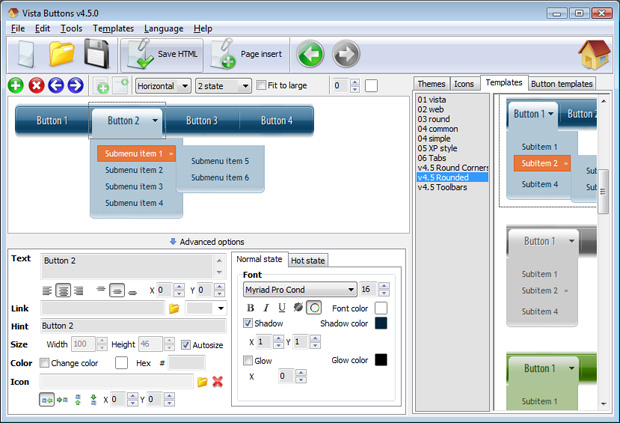
    Save menu

    You can enter any name you like, for example enter "menu":
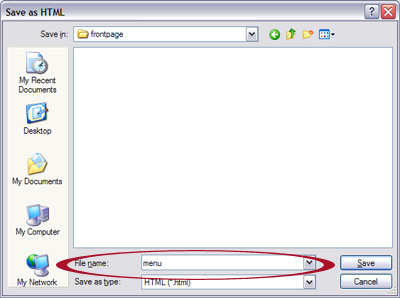
    Save menu name

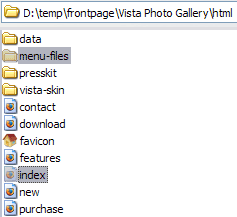
    So you'll have menu.html file and "menu-files" folder with all menu files.
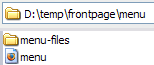
    Generated files

    2). You can add javascript popup menu to a single page or to many pages using Shared Borders, Include Page or Dynamic Web Template so that you won't have to add it into each page separately.

    Insert a popup menu to many pages using Dynamic Web Template in FrontPage

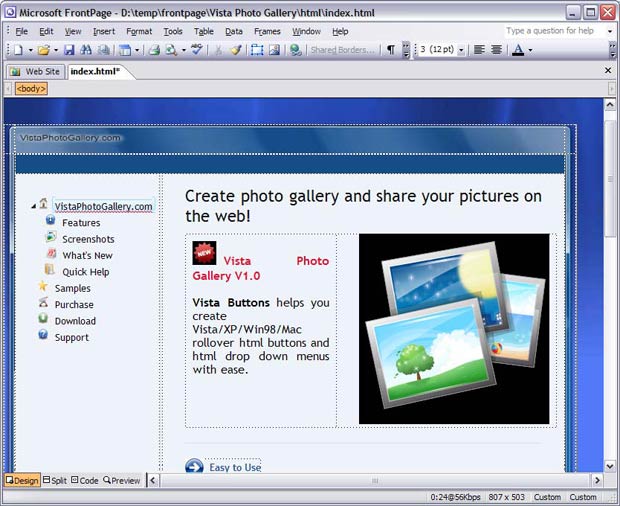
    - Start FrontPage and open your website. When the website opens, it should look like this:

    Open website in FrontPage

    - To create the Dynamic Web Template you should do the following things:
    Create a new folder in the root of your website, for example "menu". In this folder create a new Blank Page and name it menu.dwt.

    Dynamic Web Templates

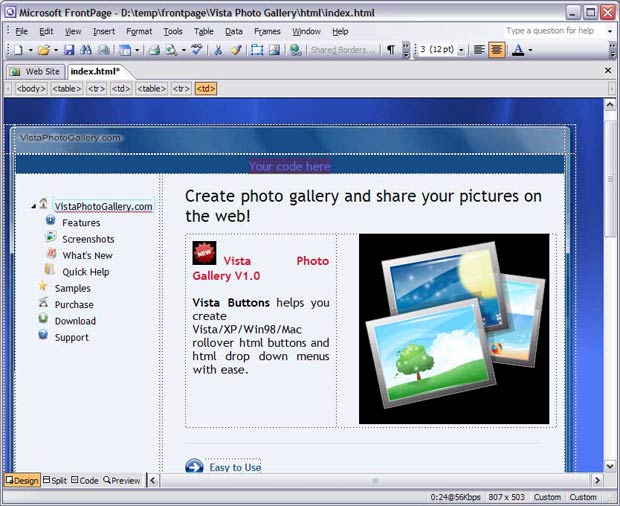
    - Now you can add a menu in Dynamic Web Template. Open menu.dwt page (double-click menu.dwt in Folder list window) and switch to the Design view mode. Decide where you would like the popup menu to appear in your page. Click in the spot you want the code to appear in and type the phrase: your code

    Dynamic Web Templates add menu

    - Open the generated in Vista Buttons menu.htmlpage in any text editor. Copy all code within the following tags:
          <!-- Begin Vista-Buttons.com -->
            ...
          <!-- End Vista-Buttons.com -->

    - We will now be inserting the JavaScript code into the body section right where we typed the phrase in the previous step. To do this, switch to HTML View.
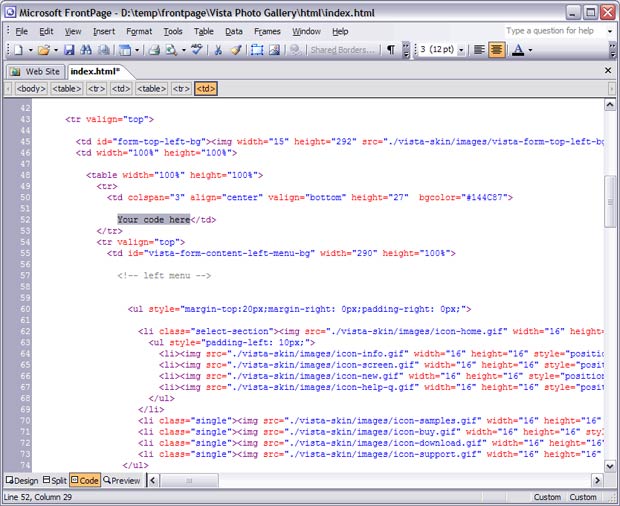
    - Go to the "Edit Menu" with FrontPage and select the "Paste" option to paste the menu code that we copied to the clipboard earlier. Since the phrase we typed was highlighted, it will be replaced when we paste the code in.
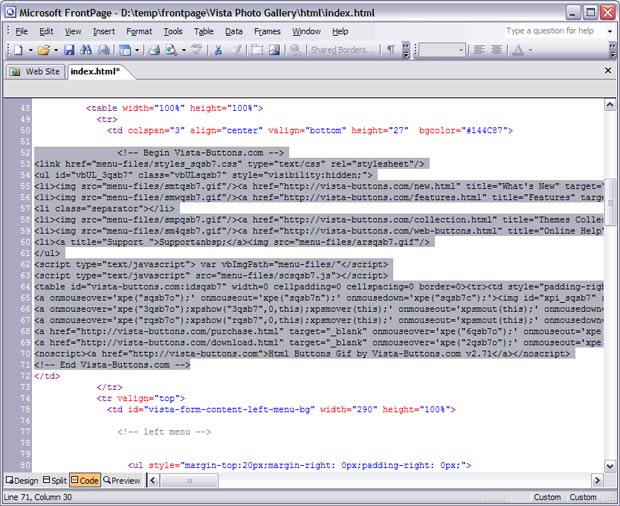
    Dynamic Web Templates add menu code

    - To display the mouseover state images correctly you should change vbImgPath parameter. Find the following code
    var vbImgPath="menu-files/"
    and change it to
    var vbImgPath="menu/menu-files/"

    Change path prefix in FrontPage

    - Now you should copy the "menu-files" folder into the same folder with your menu.dwt page.

    Copy menu files in FrontPage

    - Select the Preview mode to display the menu.dwt page live (in Internet Explorer). Notice that your mouseover images can be not displayed when you hover over menu items in the Preview mode. It is normal. You'll see all images when you open index.htm page in the Preview mode.

    Preview mode in FrontPage

    - Add editable regions to a Dynamic Web Template.
    a. Open the Dynamic Web Template (.dwt) file.
    b. In Page view, at the bottom of the document window, click Design.
    c. Put your cursor below the menu
    d. Right-click and then click Manage Editable Regions.
    e. In the Region name box, type a name for the editable region, for example, Header, Body, or Footer.
    f. Click Add, and then click Close.

    Dynamic Web Templates Editable Regions

    - Attach a Dynamic Web Template to your pages.
    a. Open the Web page you want to attach a Dynamic Web Template to.
    To attach the Dynamic Web Template to more than one page, select the pages you want.
         * In the Folder List, hold down CTRL and click each page you want.
         * If the Folder List is hidden, click Folder List on the View menu.
    b. On the Format menu, point to Dynamic Web Template, and then click Attach Dynamic Web Template.
    c. Locate and click the Dynamic Web Template (menu.dwt) you want to attach, and then click Open.
    d. In the appeared windows click "Ok" and then click "Close".

    Dynamic Web Templates Attach Template

    - That's all. You've added all necessary code to your page, so let's test it. Open your index page (double-click index.htm in Folder list window) and switch to the Preview mode.

    Result

    - If everything goes well, save and publish your website. If something seems wrong, double-check that you followed all the steps correctly.

    - If you still run into trouble, we'd be happy to assist you further. You can post your problem to us at , and meanwhile describe your files in details.



Support

Please contact Customer Support at (please include template name in the message title)



FAQ


See also

Microsoft Expression Web training course & tutorial on DVD from Microsoft Expression > Microsoft Expression Web Looking at ASP.net & Data Binding Controls Lesson 3: Dynamic Web Templates (56 min) 1. Creating an Image Map

ASP.NET data binding overview Data Binding Expression Syntax http://msdn2.microsoft.com/en-us/library/bda9bbfx(vs.71).aspx Sub rptr_OnItemDataBound(ByVal sender As Object, _ ByVal e As System.Web.UI

ASP.NET Wiki: Data Access: LINQ: Lambda Expressions Lambda expressions provide a concise, functional Saving and Calling a image from SQL Server DB Assembly Redirection Doesn't work in web.config (Assembly Binding Bug)

Microsoft Expression Web Course Outline | Total Training Start learning Microsoft Expression Web today Looking at ASP.net & Data Binding Controls Chapter 3: Dynamic Web Templates (56 min) 1. Creating an Image Map

Binding Component Values and Instances to External Data Sources Similarly, the part of the value-binding expression after the corresponding to the North America part of the image the context initialization parameters for this web

Binding to XML Data in ASP.NET 2.0 Developer.com ASP.NET 1.0 featured easy binding of user interface you could bind data to the user interface of a Web page Click here for a larger image. I selected the XML File

Binding to XML Data in ASP.NET 2.0 Developer.com ASP.NET 1.0 featured easy binding of user interface you could bind data to the user interface of a Web page Click here for a larger image. I selected the XML File

INFO: Roadmap for Web Forms Data Binding Set the graphic of an Image control by binding its ImageUrl property to a The "Data-Binding Expressions for Web Forms Pages" Web site describes how Web

Data Binding Single-Value Web Server Controls at Design Time or the ImageUrl property of an Image control If you want to create your own data-binding expression or For more information, see Data-Binding Expressions for Web Forms

StarterKits for Silverlight and Expression Image Galleries. ME; Silverlight. Facebook; Twitter couple of Silverlight concepts like data binding Using Expression Webs Publishing Feature to Deploy Your Web

Expression Web 2 Training: Antall Training Adding a Background Image ; Editing Images Directly in Expression Web; Exercise 5: Add Images for Navigation Data Binding. Database Basics: Introduction to SQL; Creating an ASP

Data Binding Single-Value Controls at Design Time property of a TextBox or the ImageUrl property of an Image control Data Binding Expressions for Web Forms Pages and Data Binding Expression Syntax. Add code to the Web Forms

Image Binding Java : Data Binding with Castor, Practical data Data Binding Expression Syntax . Data Binding Expression Syntax is a web based tutorial in which author Image Binding In Grid View Code Behind

Binding Silverlight 2s {Binding} expression allowed you to specify the name of the property you Silverlight 3 beta comes with a set of exciting web services features that

ASP.NET Web Control for Showing Image Slides images in a directory inside a slide show web control to be viewed ina web browser Expression Studio

Microsoft Expression Web Training: Introduction to Microsoft Microsoft Expression Web is Microsoft's state-of-the-art Setting Image Formats; Creating Links; Adding Links Publishing to the Web; Data Binding; Introducing Data Source